




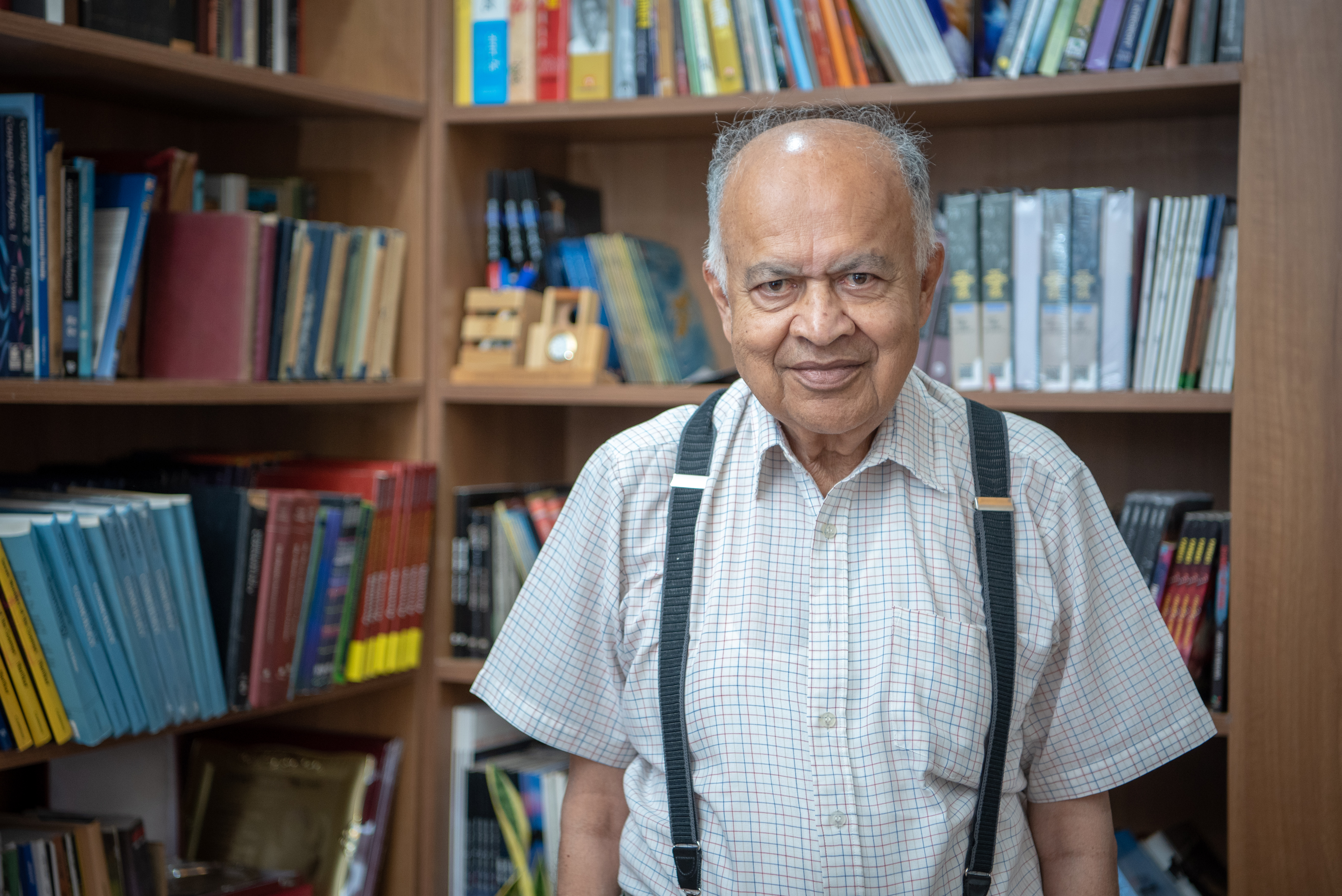
Professor Narlikar was internationally renowned for his pioneering contributions to cosmology, particularly for developing and advocating alternative cosmological models to the widely accepted Big Bang theory. His research encompassed the frontiers of gravitation and Mach's Principle, quantum cosmology, and action-at-a-distance physics. He also made significant contributions to the study of quasars, black holes, and the search for the oldest stars in the Universe.
Professor Narlikar also broke new ground in space research through an innovative programme of high-altitude balloon experiments. He led a multi-institutional team of scientists in pioneering missions that collected air samples from altitudes of up to 41 km to search for microorganisms in the upper atmosphere. Biological analyses of samples collected during the 2001 and 2005 missions revealed the presence of viable cells and bacteria, raising the intriguing possibility that the Earth is continually bombarded by microorganisms from space, some of which may have contributed to the origin of life on our planet.
In recognition of his outstanding contributions to science, Professor Narlikar was awarded the Padma Bhushan in 1965 at the remarkably young age of 26. He was subsequently conferred the Padma Vibhushan in 2004. In 2011, the Government of Maharashtra honoured him with the Maharashtra Bhushan, the State's highest civilian award. In 2025, he was posthumously conferred the Vigyan Ratna, India's highest science honour, under the Rashtriya Vigyan Puraskar.