




Solar and Stellar Physics
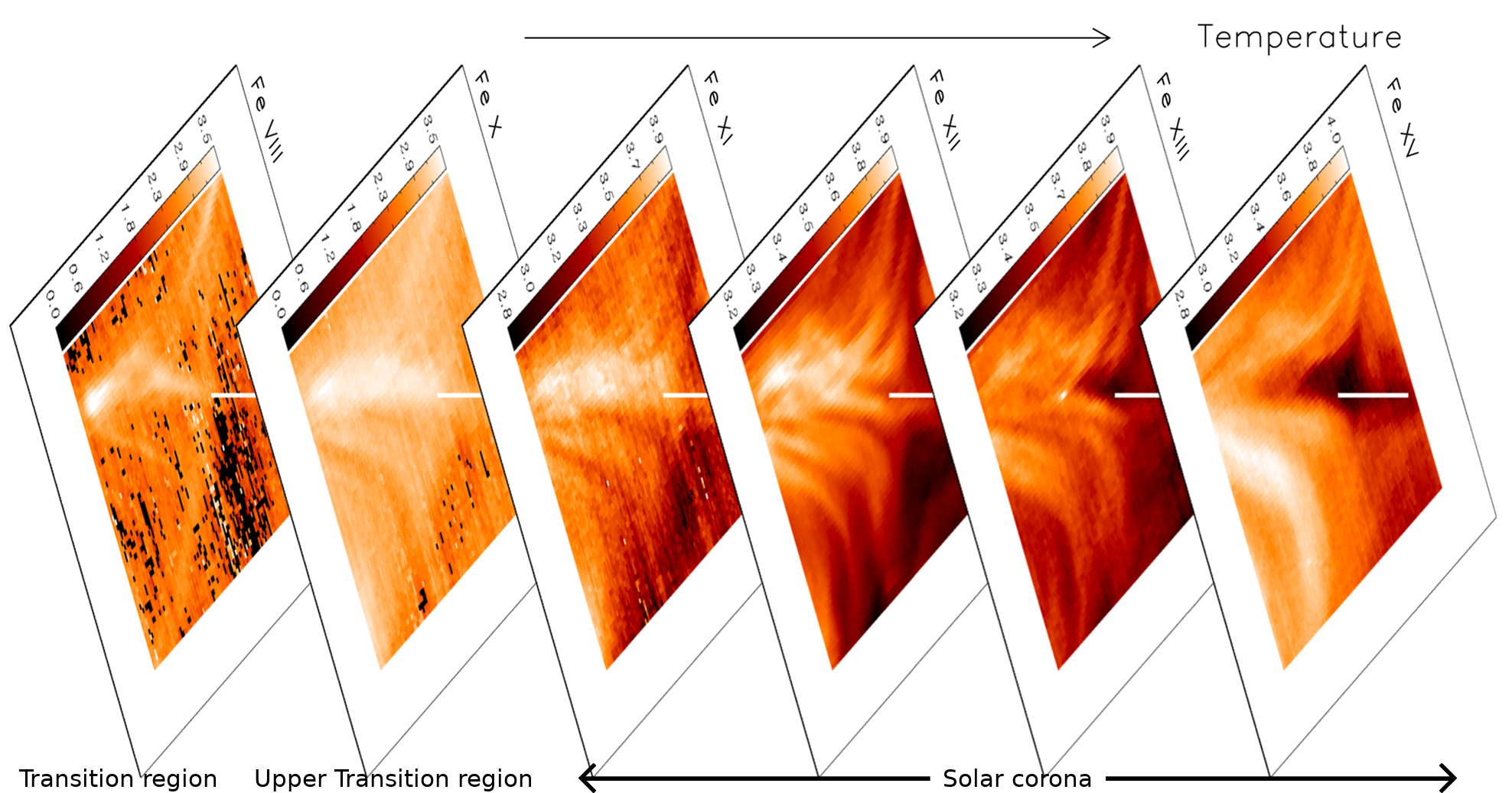
The group is interested in unravelling the physics of the magnetic coupling and dynamics of the solar atmosphere including its role in shaping up the space weather and climate using imaging and spectroscopic observations aided with hydrodynamic, magneto-hydrodynamic simulations, and machine learning. Prof Durgesh Tripathi is the Principal Investigator of the the brand new Solar Ultraviolet Imaging Telescope (SUIT) onboard Aditya-L1 mission and providing, for the first time, observations of the lower and middle layers of the solar atmosphere in near and mid ultraviolet (200-400 nm) radiation using 11 different filters. These observations are providing wealth of information and constraints on various activities occurring in the magnetised solar atmosphere. Moreover, these are also providing information in the wavelength range central to the Sun climate relationship.
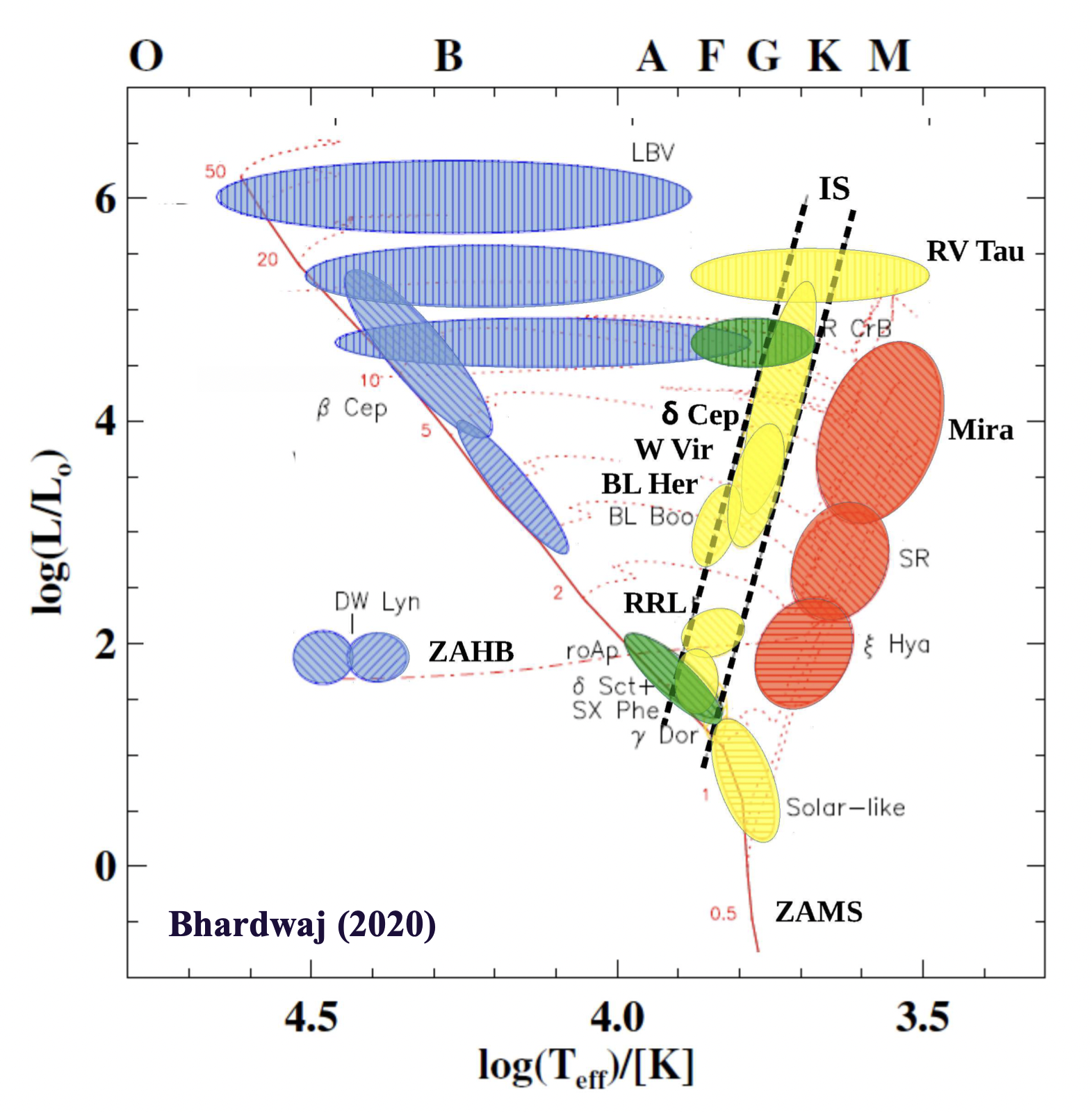
The IUCAA'STARS group is interested in stellar evolution and pulsation across the Hertzsprung-Russell diagram, Galactic archaeology, resolved stellar populations in star clusters and nearby galaxies, and near-field cosmology. The ongoing research is focussed on astronomical distances using stellar standard candles for improving the precision of the cosmic distance ladder and determining the present expansion rate of the Universe. We are involved in several ongoing ground and space-based time-domain surveys and the upcoming Vera C. Rubin Observatory's LSST survey. We are also interested in stellar evolution and pulsation modeling using open-source 1D code in Modules for Experiments in Stellar Astrophysics (MESA) software, and astrostatistics and data science applications in time-domain astronomy.
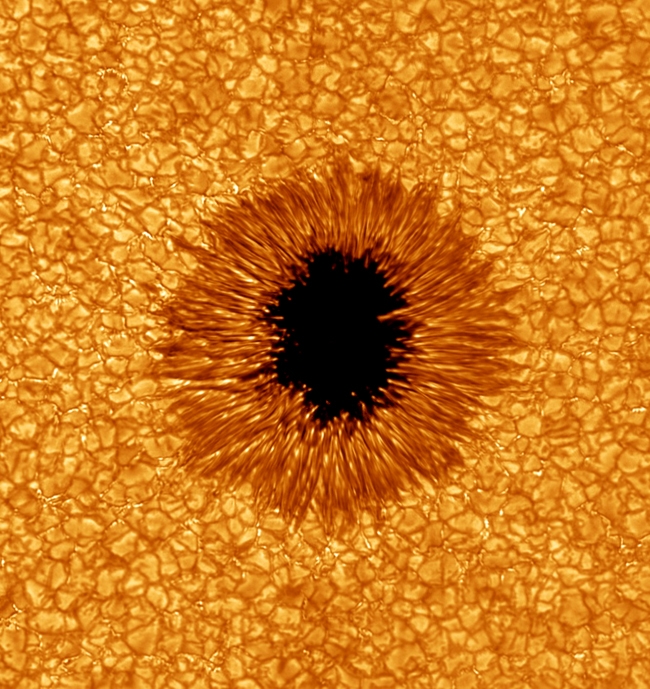
(i) Solar Magnetism Origin of solar magnetism is yet to be fully understood. Many dynamo models with very different physics have successfully shown solar-like cyclic global magnetic activity. Spontaneous formation of localized magnetic structures, resembling active regions (ARs) or sunspots, has proved to be more challenging in advanced simulations of turbulent magneto-convection. By analysing archival data from various solar observatories, IUCAA researchers study the nature of solar magnetic fields by measuring solar magnetic helicity, a quantity which is an invariant in ideal MHD and constrains the generation of magnetic fields. By combining the results of their numerical experiments with the relevant observational findings, IUCAA researchers are aiming to better understand the origins of solar magnetic fields and sunspots (see figure *SUNSPOT* as an example of the observed sunspot).
(ii) Strengthening of the solar surface gravity or the f-mode as a precursor to active region formation on the photosphere The Sun supports a wide variety of waves that carry useful information about the inhomogeneous solar structure. Earlier works have shown that the solar surface gravity or the f-mode displays strengthening about two days prior to active region (AR) formation and thus it provides a new precursor for AR formation. This has implications for space weather forecasting and can potentially be important for constraining dynamo paradigms of the Sun. IUCAA researchers continue to engage in this topic by extending the earlier works to include more examples from both, the isolated and magnetically quieter regions to better constrain the effects of existing ARs on the local f-mode strengths so that the signals from newly emerging ARs can be better assessed.

Faculty working in these areas: