
Uncategorised

Gravitational lensing (Strong, Weak and Micro)

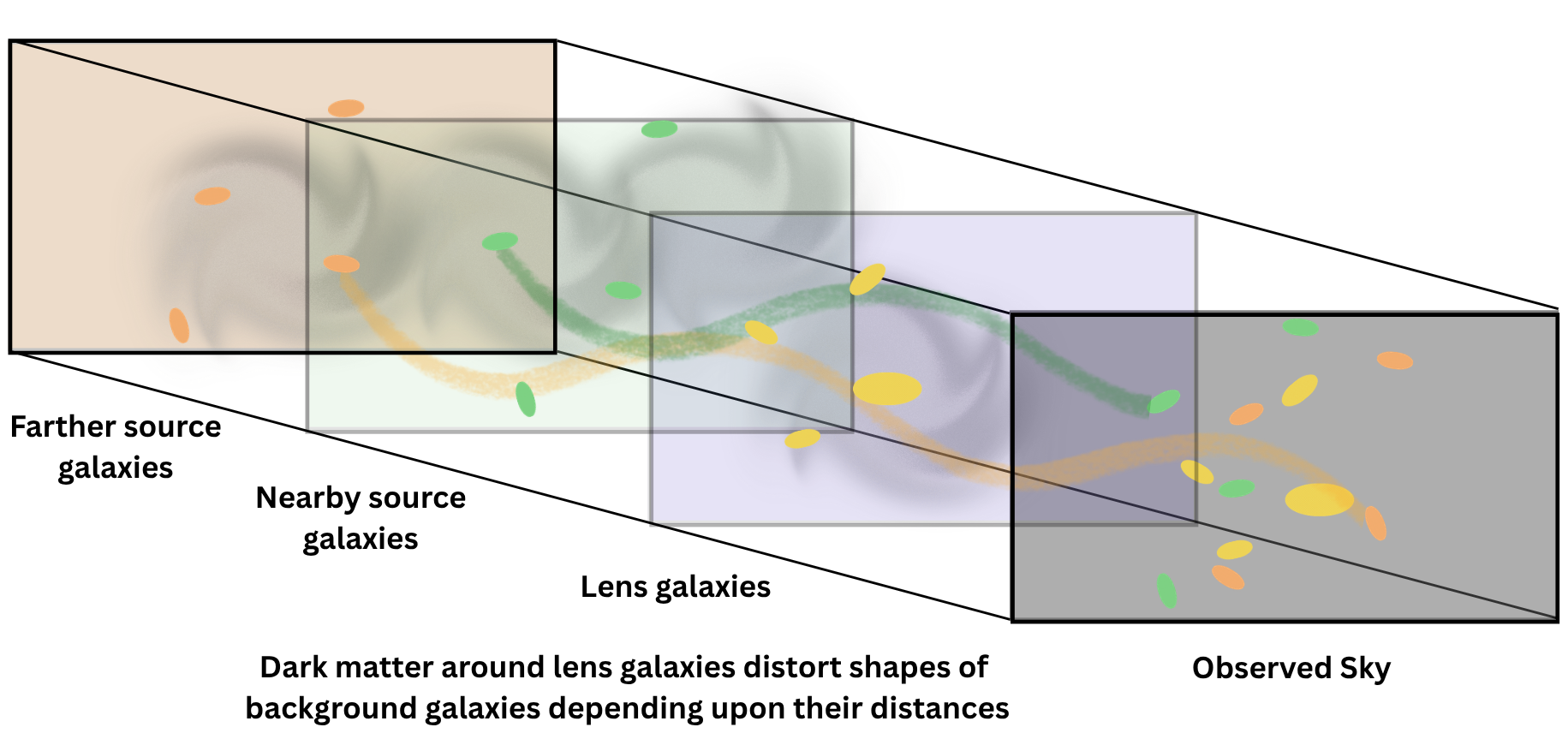
Gravitational lensing is the deflection of light from a distant source due to the gravitational potential of an intervening mass to the observer. In weak lensing, we carry out a statistical study of weaker distortions to the distant galaxies due to massive galaxies or galaxy clusters at lower redshifts. In strong lensing, multiple images of a distant source such as a galaxy or a quasar are formed which allow us to address many questions related to cosmology and galaxy formation and its evolution. In extra-galactic microlensing, the compact stellar population causes perturbations to the properties of the strongly lensed images.  
At IUCAA, research is ongoing in diverse areas of strong lensing from galaxies to cluster-scales using data from large imaging surveys such as the Hyper-Suprime Cam Survey and the Dark Energy Survey. LSST Survey data, in the near future, will also offer exciting challenges for detecting and analyzing large samples of gravitational lenses. The (strong/micro-)lensing of gravitational waves is also one of the research focuses at IUCAA.

A strong gravitational lens discovered from the Hyper Suprime Cam (HSC) Survey shows a galaxy group (yellow galaxies) lensing distant galaxies in the background (multiple blue knots and arcs). Detailed analysis of such systems can help probe the mass distribution of such galaxy groups and improve our understanding of the role of dark matter and the luminous mass (stars+gas).

Cosmology and large scale structure


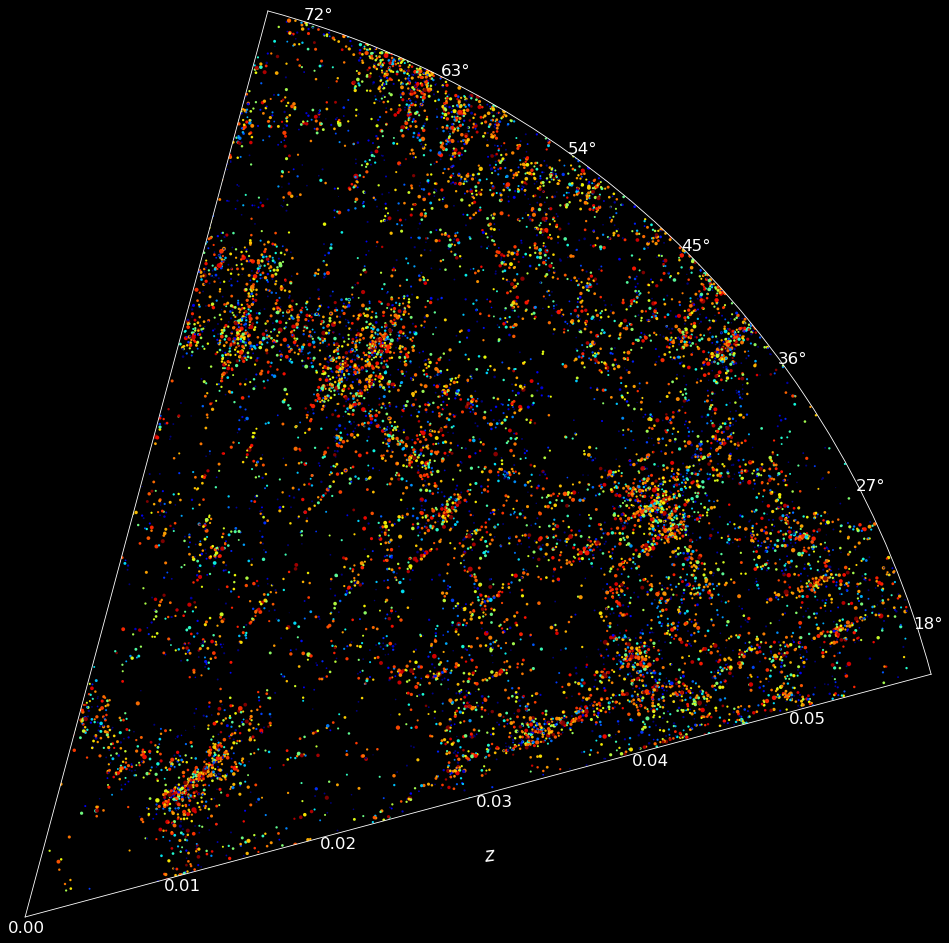
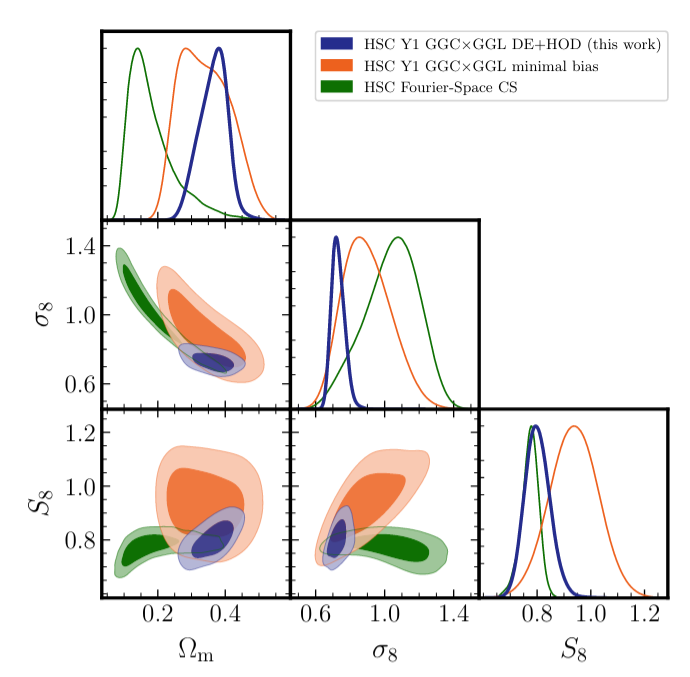
Research at IUCAA in Cosmology and Large-Scale Structure (LSS) explores a number of areas using both observational and theoretical techniques, ranging from fundamental questions such as the nature of dark matter and dark energy — including standard and alternate cosmological models — to the phenomenology and physics of the Cosmic Web. Aspects of the latter include the relationship between cosmic tracers like galaxies and the ubiquitous dark matter distribution, the formation and evolution of these galaxies and galaxy clusters, the evolution and properties of the inter-galactic medium at both early and late epochs, and the origin and evolution of cosmic magnetic fields which pervade the Cosmic Web at all length scales. Understanding the multi-scale properties of the Cosmic Web, which is the stage on which the evolution of observable tracers plays out, allows these tracers to become sensitive probes of fundamental cosmological questions. IUCAA researchers are actively addressing these questions using tools ranging from analytical and semi-analytical techniques to state-of-the-art numerical simulations, as well as observational data from large-volume surveys of the local and high-redshift Universe.